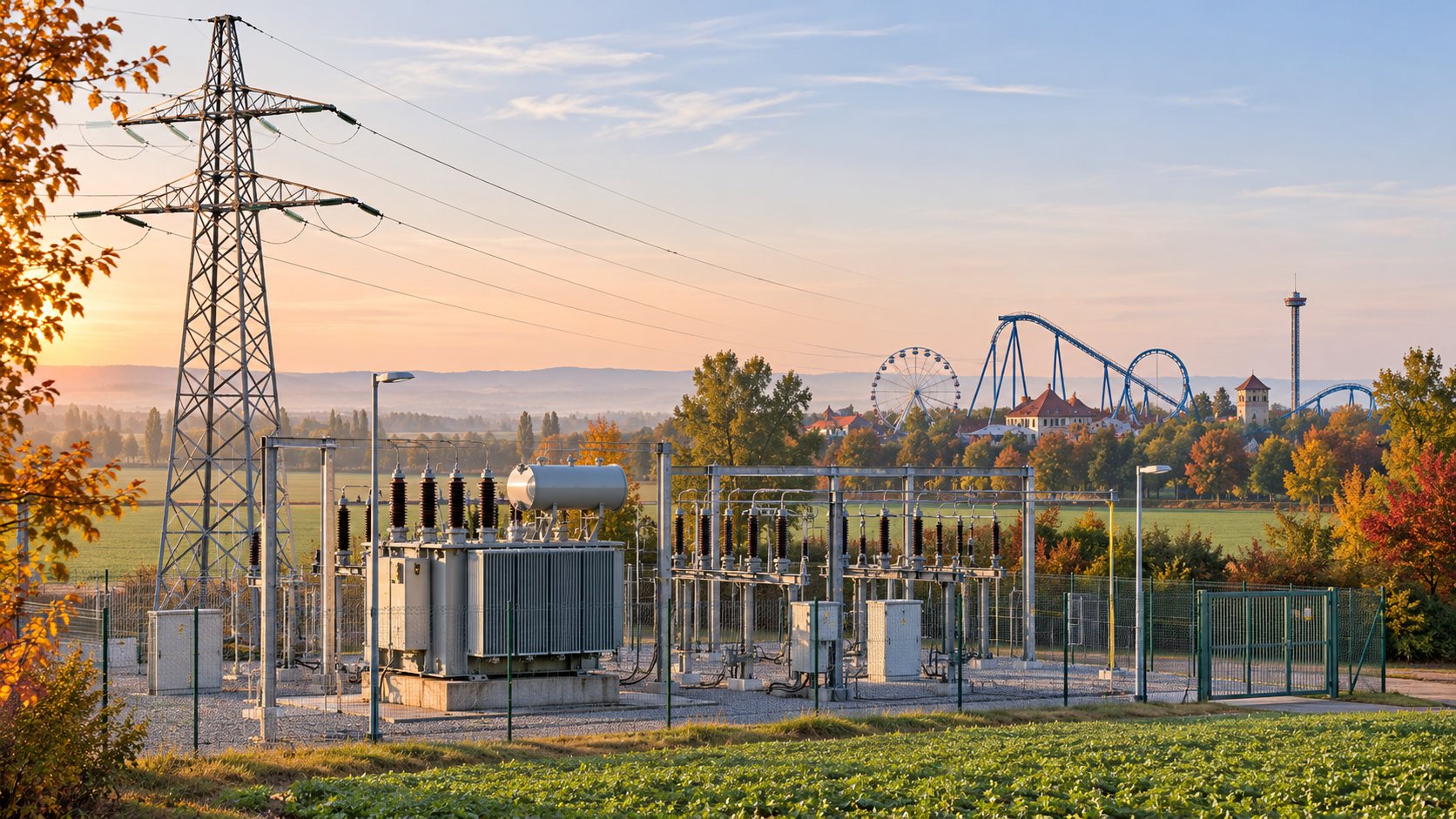
A new space-themed area with a family roller coaster is due by 2028 on the site of the former Euro-Mir ride. Rulantica water park also plans to open Nørd Havn in late 2027. Europa-Park told broadcaster SWR that its space-themed area is unaffected by the grid bottleneck. Power supply is expected to matter more for later projects as the park plans more chargers for cars and buses and wider use of heat pumps.
Rising demand meets a grid near capacity
The bottleneck is in the regional 110 kV grid. According to E-Werk Netze, available capacity in parts of Ortenau is largely used up. New or upgraded connections above one megawatt are currently usually unavailable there. Netze BW says new power requests in 2025 alone amounted to around half the region’s existing peak demand.
Grid upgrades are under way. Netze BW told SWR that the first improvements around Lahr are expected from 2032, with full expansion planned between 2035 and 2037. Europa-Park is meanwhile using its own solar, hydropower and combined heat and power generation. It is also considering battery storage.
Grid expansion has to reach individual sites
As of June 30, 2026, Germany’s Federal Network Agency tracked about 16,879 kilometres of transmission expansion projects covered by federal legislation. Some 2,983 kilometres were fully operational and another 1,865 were complete and awaiting commissioning. Those figures cover major transmission lines and exclude regional distribution networks such as Ortenau’s.
For a business, the practical question is how much power it can draw at its site and when. A new long-distance line alone delivers no extra local connection capacity if the regional grid or a substation is already full. Whether a charging hub, factory or theme park can expand also depends on upgrades reaching the places that need the additional capacity in time.