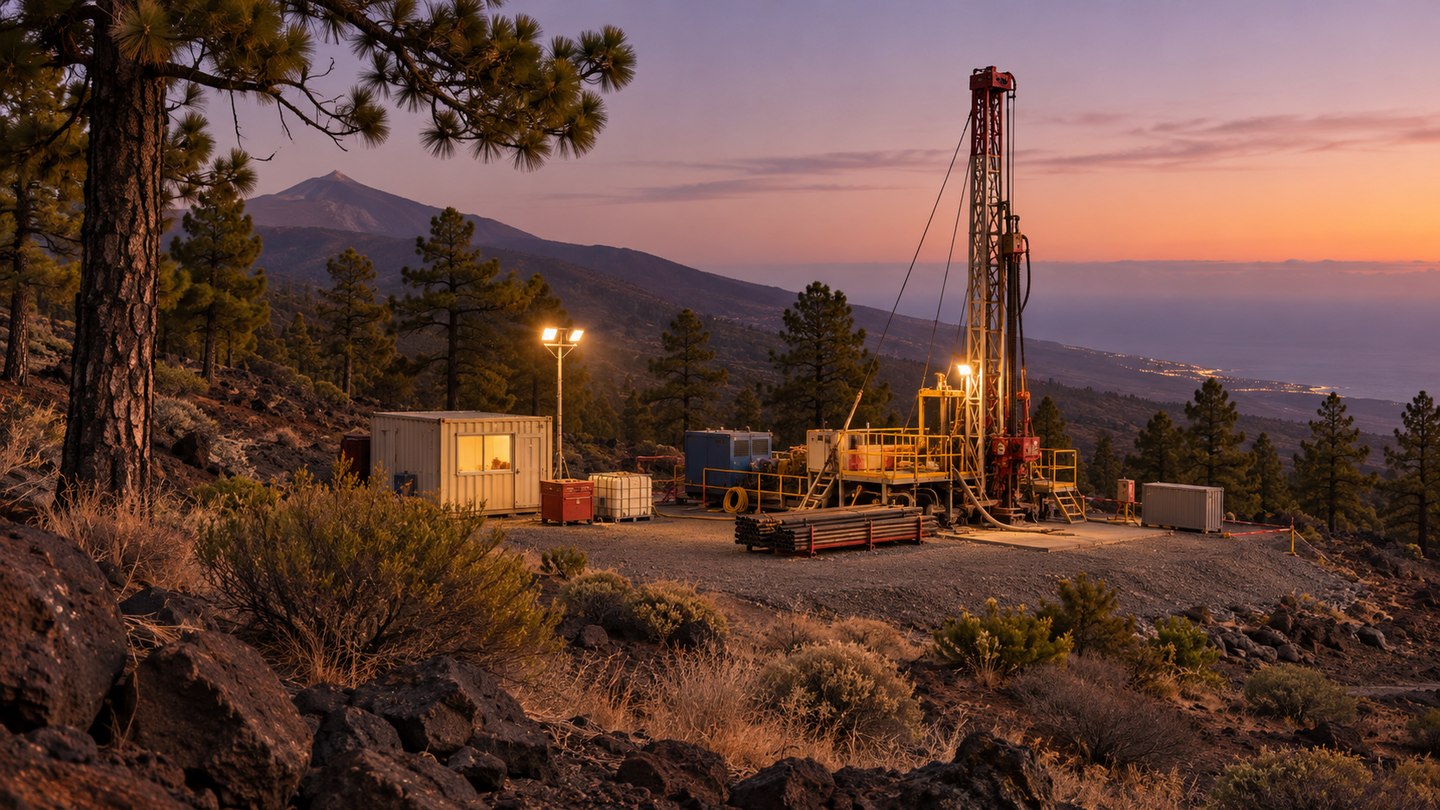
When the sun sets over Vilaflor, the solar panels stop generating. Almost three kilometres below, the time of day makes little difference. Initial measurements in the volcanic rock beneath Trevejos point to fluid at about 150°C and a pressure of around 30 bar. Tenerife’s island council had already reported early signs of a geothermal resource in September. The project team presented its drilling progress during a technical visit on 12 November. The Canary Islands edition of elDiario.es reported on it on 27 November.
Twelve metres apart at the surface
The first well is about 3,000 metres long along its path and reaches more than 2,800 metres vertically. The second well starts on the same pad, just twelve metres away. The two paths diverge underground, allowing the team to investigate different parts of the rock from a single site. Three wells are planned in total. Tenerife’s island council, Spanish energy company DISA and Iceland’s Reykjavík Geothermal are behind the project. The exploration is co-funded by the EU.
What the rock can supply
Hot water can be present deep underground and still flow too slowly into a well. That is what the next tests are designed to establish. The team wants to measure how much fluid can be brought to the surface over time and how pressure responds as it is withdrawn. The project also needs to determine whether the cooled water can be reinjected underground.
At around 150°C, a binary-cycle power plant could be an option. The hot water transfers its heat to a second fluid that boils at a lower temperature. The resulting vapour drives a turbine. How much power would reach the grid depends in part on how much hot water flows into the well and how much electricity the pumps use.
Why the night matters in Tenerife
According to the Canary Islands Energy Observatory, renewables integrated into the grid accounted for about 18.4% of Tenerife’s electricity generation in 2025. For the island, the timing of geothermal generation would also matter. On a night with little wind, a plant could replace some fossil-fuel generation while the solar panels wait for morning. The size of that contribution depends on how much power Vilaflor can sustainably deliver.
Those 150 degrees explain why the search is worth pursuing. Whether Tenerife can one day generate geothermal electricity after dark comes down to another figure. How many litres per second can the rock keep supplying?