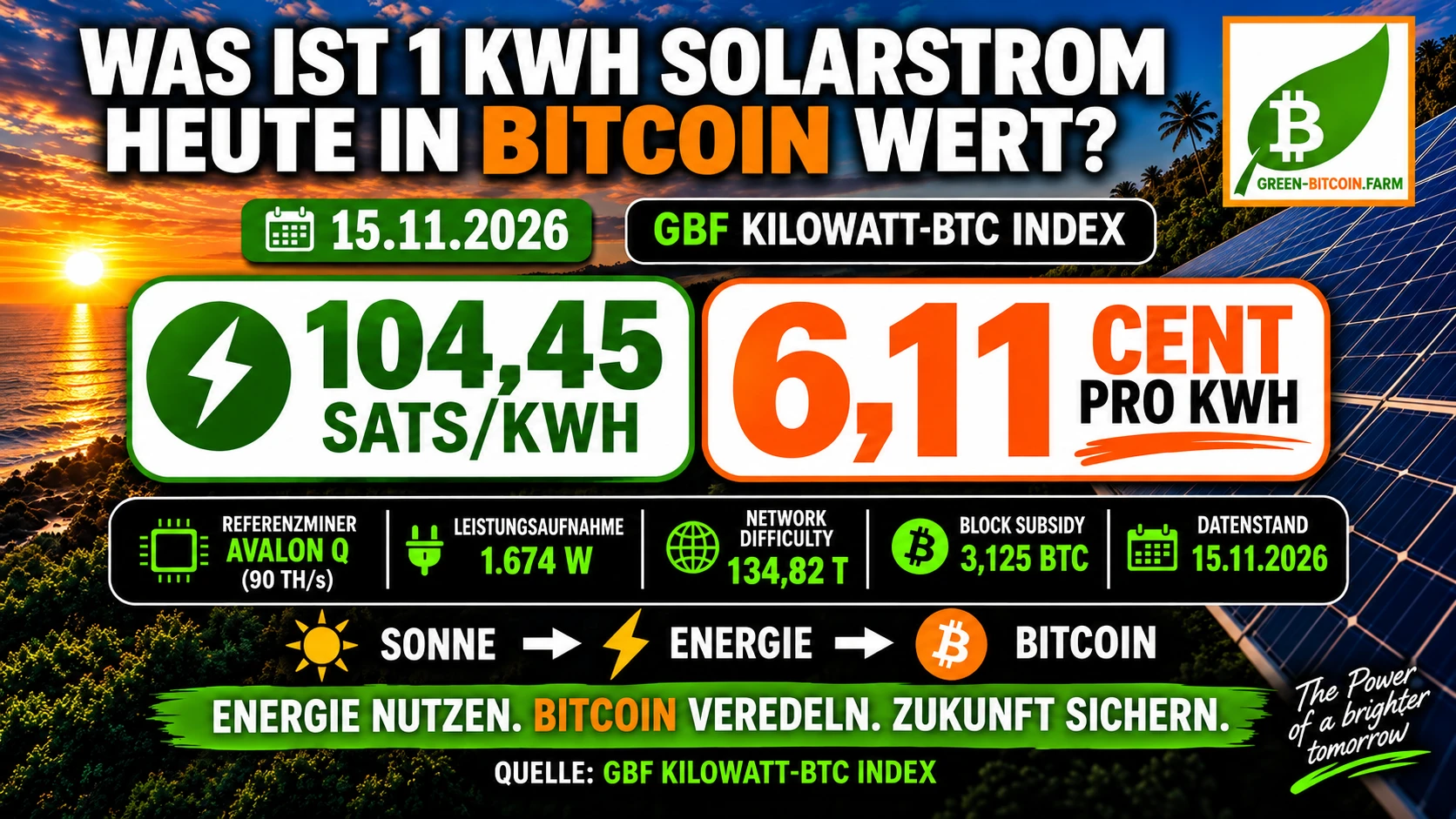
Almost the same sats per kilowatt-hour
Our September 22, 2026 GBF graphic showed 106.07 sats per kWh. On November 15, the same index calculates 104.45 sats using the Avalon Q reference miner, a decline of only 1.53% between the two dates. These are two snapshots, not evidence of uninterrupted stability. September figures are taken from our original GBF post, not reconstructed from a daily historical series.
Why the euro value has fallen further
The earlier graphic showed 7.93 euro cents per kWh; today's value is about 6.11 cents, roughly 23% lower using the rounded figures. Today's conversion uses the initial Kraken reading of €58,512.40 per Bitcoin. It is a point-in-time conversion, not a daily closing price. Sats per kWh measure expected Bitcoin output; euro cents express that output at a particular exchange rate.
The fixed GBF method
The reference miner is an Avalon Q at 90 TH/s and 1,674 W. Retrieved difficulty is 134,823,837,323,272.7, with a 3.125 BTC block subsidy. The fixed formula combines hashrate, runtime per kWh, subsidy and difficulty to produce approximately 104.45 sats per kWh. Bitcoin's exchange rate enters only when converting to euros.
This is a theoretical expectation from the block subsidy alone. Transaction fees are excluded; pool fees, downtime, electricity and equipment costs are not deducted. It is neither a guaranteed payout nor profit or a fixed export tariff.
The GBF perspective
For our Tenerife farm concept, the useful question is how many sats a surplus kilowatt-hour could generate. Today's answer is close to our September snapshot even though the euro value has changed substantially. We still compare mining with direct consumption, storage and possible export. The index makes expected mining output comparable; the best use depends on actual costs and the value of alternative uses.